
Our complete guide of the vinyl cutting machines has been specially curated for you to offer the best guide possible, as well as the pros and cons of each product based on size, ease of use, the capacity of the machines, and how well they operate.
What we have cover!
1. Personal (Desktop) or Commercial Cutters?
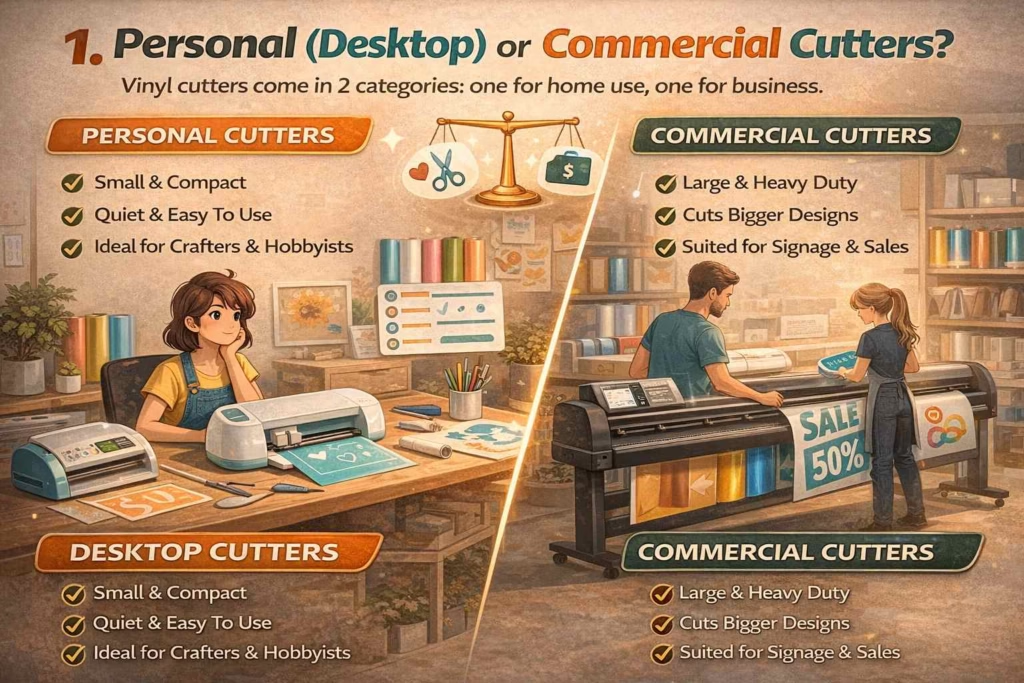
The vinyl cutters come in 2 different categories: one for personal use and the other for commercial use. Your present need will determine the one you end up buying. So what are the differences between personal and commercial cutters?
+ Personal Cutters or Desktop Cutters: They need something small enough to fit their home office, preferably their desktop; something quick and easy to use that can be operated quietly without disturbing the kids or waking up the neighbors, and a cutter that is simple for anyone to operate, irrespective of their experience in vinyl cutting.
+ Commercial Cutters: Commercial businesses will be using their cutters for signage and other large roster-demanding work for their clients. These kinds of cutters are physically large, a bit expensive with the ability to cut large designs and other materials. Individual cutters, on the other hand, are for those whose needs for cutting are not to the extreme.
Note: It is worthy to note that just because a machine is built to cut bigger designs doesn’t mean it will cut them well. Only buy a big machine if you know you need to cut larger designs.
2. Drive Motors – Stepper Motors vs Servo Motors
The engine of a vinyl cutter determines its power and how well it operates. There are 2 kinds of drive motors: stepper motors and Servo Motors.
+ Stepper Motors: The mechanical stepper motors move in ‘steps’ and are driven by a physical gear. They are mainly used to save costs, but the downside could be costly, as they are quite noisy during operation. There is also the issue of some graphics losing their precision.
As with most things that are large, it finds it easy to cut them accurately, but on characters that are less than half an inch, the size prevents it from being able to plot the path smoothly.
Servo motors have become the standard for high-end hobbyist and professional machines. The big change for 2026 is the closed-loop system. Unlike basic stepper motors, a servo motor uses a sensor to constantly check its own position. This makes the machine much quieter and ensures the blade stays perfectly on track, even when cutting at high speeds.
For cutters driven by digital servo motors, an encoder translates the command from the software commands into ones and zeros, which results in a smooth, precise movement of the drive motor over the cutting head.
Note: The Servo Motors operate at a quieter level compared to the mechanical stepper motor since it doesn’t have mechanical gears, as well as being able to turn and pivot along smaller paths with precision. It can cut smaller letters with as much precision as it cuts larger materials.
3. Price – You Get What You Pay For
When it comes to vinyl cutters and even most things in life, you get what you pay for. Indeed, most of the time, an expensive machine might not be the most functional, but we also can’t ignore the fact that the most expensive vinyl cutters are also the highest quality ones that can take on different and delicate designs. They can produce results without a hitch as they have the highest quality blades for the most precise cuts possible.
This, however, doesn’t mean that cheap machines are not worth your time because some of the latest desktop vinyl cutters that are not expensive are also some of the best sellers on the market.
New Features of the Vinyl Cutting Machines
Vinyl cutters have continued to evolve, with 2026 being the year we saw a lot of the popular vinyl cutters emerging with new features. Some of the major features that we came across include:
1. Software
Design software now acts more like an assistant than a basic tool. Newer versions of Cricut Design Space and Silhouette Studio include generative AI, where you can just type in what you want, like a minimalist mountain logo, and the software builds the cut-ready vector for you. There is also an auto-nesting feature that handles the layout for you by rotating and packing designs together to help save on vinyl waste.
2. Wireless capacity
The top desktop cutters on our review list below now have a wireless function via Bluetooth, meaning you can design on your tablet in one room and send the design to the craft cutter in another room without having to connect any cables, as was previously done.
3. Automatic settings
Today’s vinyl cutters don’t require you to fiddle with anything to get a feel for what needs to be done and when. They can automatically adjust themselves to a range of materials at the flick of a switch within the machine.